Moving-with Climate Change

During 2025 and 2026, I led the performance practice-as-research project “moving-with climate change” at William & Mary, aimed at understanding how to enhance active listening through embodied movement, engaging local audiences in responding to recorded testimonies from internal and international climate migrants, measuring and analyzing the somatic impacts on listeners. This required building a new interdisciplinary approach to understanding the relationship between somatic practices, narratives and feelings about issues of social-environmental justice, to explore how audiences are (or are not) “moved” by testimonies of climate migration – which involve climate change as one of potentially many interconnected reasons for migration, related to global inequality and differential levels of vulnerability. The responsibility to respond was one of the main motivations for our research project, given that there is often a sense of disassociation among those most responsible and able to respond from those who are most impacted and vulnerable.
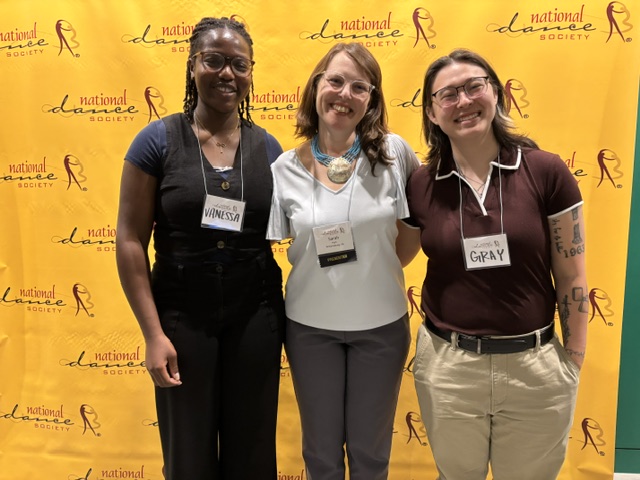
I was the PI for our interdisciplinary team of co-researchers: Vanessa Dunu, an undergraduate student majoring in neuroscience; Gray Rzezot, an undergraduate student majoring in Psychology; and Stephanie Caligiuri, Assistant Professor of Kinesiology. We started our research in May, 2025, conducting outreach to NGOs in the region that work with climate migrants (like Chesapeake Climate Action Network and National Partnership for New Americans), recording and collecting stories, conducting a literature review, and designing movement workshops to engage students and community participants. In the fall, we facilitated 4 workshops, engaging 21 research participants total. We analyzed the data in Spring 2026 and presented the initial findings at the National Dance Society conference in May at William & Mary, considering participants’ self-reported feelings and quantitative data on heartrate recorded using polar biosensor watches, as well as theoretical conversations across performance, psychology, migration and environmental humanities.
We learned that the range of feelings participants experienced in relation to climate migration was more complex than we anticipated, and self-awareness was necessary to the capacity to care and respond. Moving while listening generally helped participants feel the narrator’s experience in an empathetic way, especially when engaging with each others’ reactions by moving together. The sense of connection with each other as witnesses was essential – even though challenging emotions came up, it became more possible to engage with the testimonies of climate migration (participants no longer felt overwhelmed) through the collective effort to come together, to pay attention, and to express feelings and sensations. Awareness and resilience grew from the beginning to the end of the workshop, overwhelm decreased and disinterest disappeared. Engagement was enhanced by moving from individual reflection to connecting with a partner and then with the group, which facilitated actively listening to narratives of climate migrants, moving from an isolating feeling of hopelessness towards a more hopeful sense of being able to respond to a complex global issue.
Student Researcher reflections:

Vanessa: The complexity of interdisciplinary research showed clearly when it came to analyzing the data. This consisted of multiple trials of analyzing and illustrating the data as we figured out how we wanted kinesiology to support the research…such as what graphs we want to use, what we want the graphs to show, etc. An example is seen in finding out what we can pull from heart rate and heart rate variability. I believe we were able to use the data in order to have graphs that more clearly tell the story and relay the information in a way that flows with the performance research.
Gray: Something that’s vital in this study is how the researcher is looped into the conversation of the data. Doing the acts with the participants helps us, as the researchers/facilitators, understand more deeply and connect our research more adequately. Observation and communication through verbal means can only go so far…By engaging in our own workshops, both during and prior to the participant observation phase, we are able to more deeply understand how these participants are feeling, and ultimately, how this affects the output and understanding of data.
If you are interested in supporting climate migrants, consider donating to these nonprofit organizations:
Chesapeake Climate Action Network

